



DESTINY-Breast02: Safety Results (June 30, 2022 DCO Date)
Overall Safety Summary1
- The safety analysis set included all randomized patients who received at least 1 dose of study treatment (T‑DXd arm [n=404]; TPC arm [n=195]). At June 30, 2022 DCO, the median treatment duration was 11.3 months with T‑DXd and approximately 4.5 months with TPC.1
- Most patients experienced a TEAE (99.8% with T‑DXd and 94.9% with TPC).1
- The most common drug-related TEAEs associated with drug discontinuation for T‑DXd were pneumonitis (6.2%) and ILD (3.2%).1
- The most common drug-related TEAE associated with treatment discontinuation with TPC was palmar-plantar erythrodysesthesia (1.5%).1
| Type of Adverse Event, n (%) | T-DXd n=404a | TPC n=195a |
| Any-grade TEAE | 403 (99.8) | 185 (94.9) |
| Drug-related | 394 (97.5) | 180 (92.3) |
| Grade ≥3 TEAEs | 213 (52.7) | 86 (44.1) |
| Drug-related | 167 (41.3) | 60 (30.8) |
| Serious TEAEs | 103 (25.5) | 46 (23.6) |
| Drug-related | 46 (11.4) | 15 (7.7) |
| TEAEs associated with drug discontinuations | 80 (19.8) | 19 (9.7) |
| Drug-related | 58 (14.4) | 10 (5.1) |
| TEAEs associated with drug interruptions | 183 (45.3) | 90 (46.2) |
| Drug-related | 132 (32.7) | 76 (39.0) |
| TEAEs associated with dose reductions | 102 (25.2) | 89 (45.6) |
| Drug-related | 95 (23.5) | 89 (45.6) |
| TEAEs associated with an outcome of death | 11 (2.7)b | 7 (3.6)c |
| Drug-related | 4 (1.0)d | 0 |
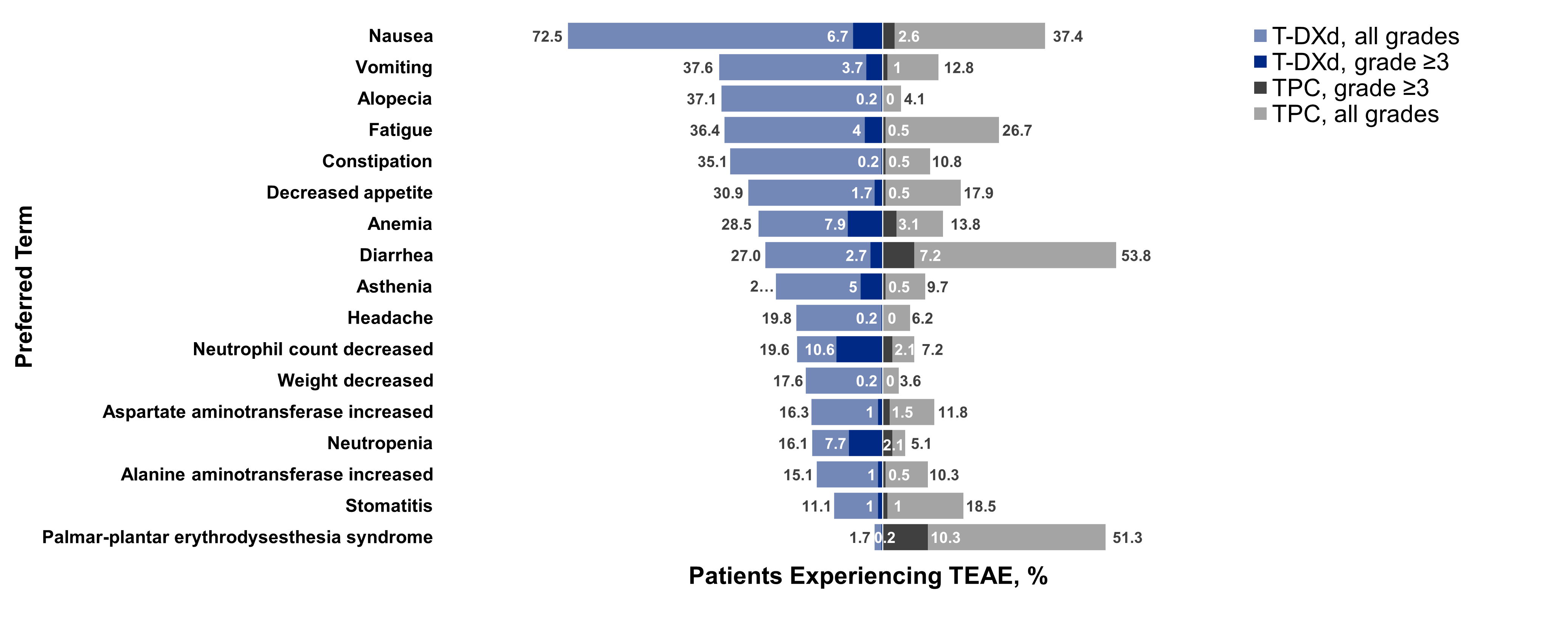
Most Common TEAE1
Most Common TEAEs (>15% of Patients in Either Treatment Arm).1
Most Common TEAEs (>15% of Patients in Either Treatment Arm).1
Adverse Events of Special Interest1
Adjudicated ILD/Pneumonitis1
| Adjudicated as Drug-Related ILDa | ||||||
| n (%) | Grade 1 | Grade 2 | Grade 3 | Grade 4 | Grade 5 | Any Grade |
T-DXd (n=404) | 11 (2.7) | 26 (6.4) | 3 (0.7) | 0 | 2 (0.5) | 42 (10.4) |
TPC (n=195) | 0 | 0 | 1 (0.5) | 0 | 0 | 1 (0.5) |
Left Ventricular Dysfunction 1
- Eighteen (4.5%) patients in the T-DXd arm experienced a LV dysfunction event, with 2 (0.5%) experiencing a grade ≥3 event. Three (1.5%) patients in the TPC arm experienced LV dysfunction, with 1 (0.5%) experiencing a grade ≥3 event.1
- In the T-DXd arm, 17 patients experienced decreased ejection fraction (grade ≥3, n=2) and 1 patient experienced LV dysfunction (grade 1). In the TPC arm, 1 patient experienced decreased ejection fraction (grade 1), and 2 patients experienced cardiac failure (grade ≥3, n=1).1
Abbreviations
DCO = data cut-off
;ILD = interstitial lung disease
;LV = left ventricular
;T-DXd = trastuzumab deruxtecan
;TEAE = treatment emergent adverse event
;TPC = treatment of physician's choice
References
Please note that this content may contain some data and/or patient populations which are considered off-label in your country. Providing this information does not constitute any recommendation for use. AstraZeneca is providing this material as an information service and professional courtesy.
To help us improve our content for health care professionals, please take this short survey.

©2023 AstraZeneca. All rights reserved.