



Study of T-DXd vs T-DM1 for Patients With High-Risk HER2 positive Primary BC in the Post Neoadjuvant Setting1,2
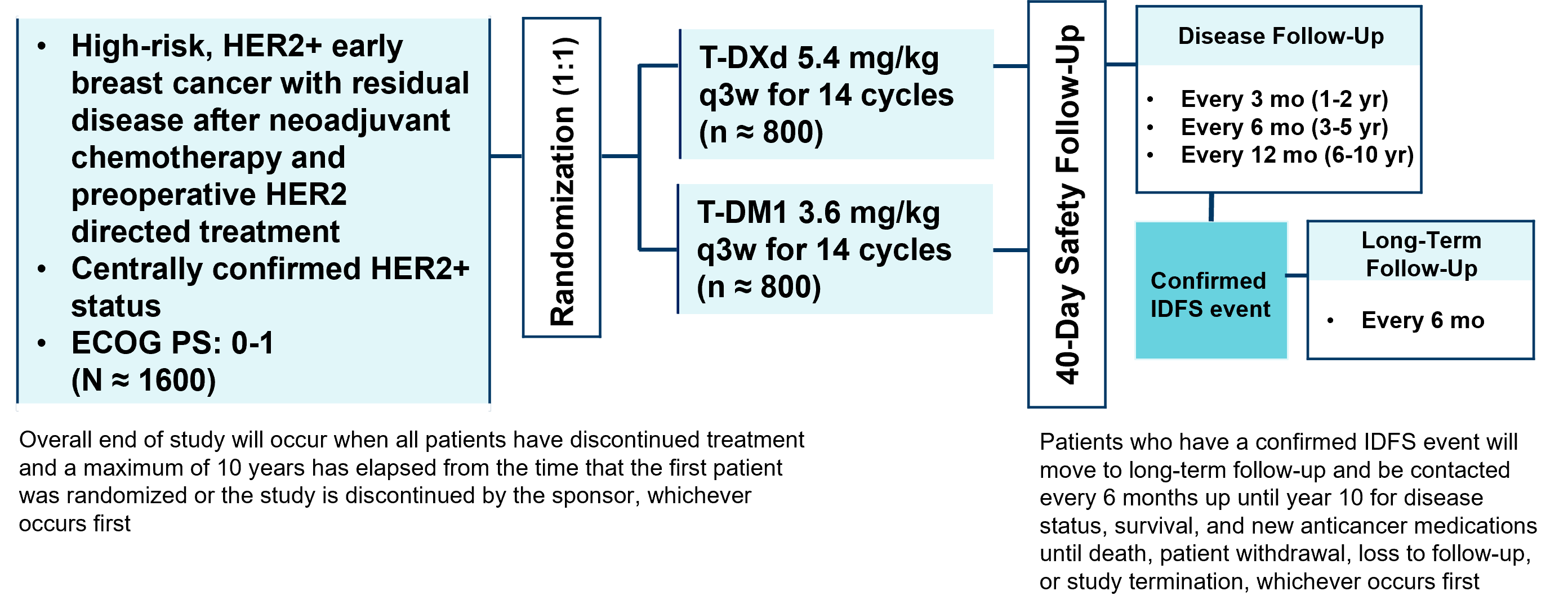
A Phase III, multicenter, randomized, open-label, active-controlled trial of T-DXd vs T-DM1 for patients with high-risk HER2 positive primary BC following neoadjuvant therapy (North America, South America, Europe, Asia, Australia)1
Study Design2
Study Design2

Key Eligibility Criteria1,2
| Key Inclusion Criteria | Key Exclusion Criteria |
| Adults ≥ 18 years old (local regulatory requirements may apply if the legal age for study participation is >18 years) | Stage IV (metastatic) BC |
| Histologically confirmed invasive BC at presentation | History of prior (ipsi- or contralateral) BC except LCIS |
| Clinical stage at presentation: T1-4,N0-3, M0 (T1N0 tumors are not eligible) | Clinically evident gross residual or recurrent disease following neoadjuvant therapy and surgery |
| Centrally confirmeda HER2-positive BC (IHC3+ or ISH+) based on pretreatment biopsy or surgical specimen | Prior treatment with T-DXd, T-DM1, or other anti-HER2 ADC |
Completion of neoadjuvant systemic chemotherapy and HER2 directed treatment
| History of exposure to the following cumulative doses of anthracyclines:
|
Pathologic evidence of residual invasive carcinoma in the breast and/or axillary lymph nodes following completion of neoadjuvant therapy meeting one of the following high-risk criteria:
| History of other malignancy within the last 5 years except for appropriately treated carcinoma in situ of the cervix, non-melanoma skin carcinoma, stage I melanoma skin carcinoma, stage I uterine cancer, or other non-breast malignancies |
| Adequate excision confirmed per medical records: surgical removal of all clinically evident disease in the breast and lymph nodes | History of (non-infectious) ILD/pneumonitis that required steroids, current ILD/pneumonitis, or where suspected ILD/pneumonitis cannot be ruled out by screening imaging |
| Adequate organ function within 14 days before randomization, ≤12 weeks between date of last surgery and randomization, and LVEF ≥50% within 28 days prior to randomization | Medical history of myocardial infarction within 6 months, symptomatic CHF, troponin levels consistent with myocardial infarction 28 days prior to randomization |
| Known HR (estrogen receptor, progesterone receptor) status per local laboratory assessment | QTcF prolongation >450 ms in males and >470 ms in females |
| Known pulmonary compromise resulting from intercurrent pulmonary illnesses or any autoimmune, connective tissue, or inflammatory disorders with pulmonary involvement |
Abbreviations
ADA = anti-drug antibody
;ADC = antibody-drug conjugate
;BC = breast cancer
;BMFI = brain metastases-free interval
;CHF = congestive heart failure
;DFS = disease-free survival
;DRFI = distant recurrence-free interval
;ECOG = Eastern Cooperative Oncology Group
;HER2 = human epidermal growth factor receptor 2
;HR = hormone receptor
;IDFS = invasive disease-free survival
;IHC = immunohistochemistry
;ILD = Interstitial Lung Disease
;ISH = in-situ hybridization
;LCIS = lobular carcinoma in situ
;LVEF = left ventricular ejection fraction
;mo = months
;OS = overall survival
;PK = pharmacokinetics
;PS = performance status
;q3w = every 3 weeks
;QTcF = QT interval corrected using Fridericia’s formula
;T-DM1 = trastuzumab emtansine
;T-DXd = trastuzumab deruxtecan
References
2. Geyer Jr CE, Untch M, Prat A, et al. Trastuzumab deruxtecan (T-DXd; DS-8201) vs trastuzumab emtansine (T-DM1) in high-risk patients with HER2-positive, residual, invasive, early breast cancer after neoadjuvant therapy: a randomized phase 3 trial (DESTINY-Breast05) [poster and abstract]. Poster presented at: San Antonio Breast Cancer Symposium (SABCS) Virtual Annual Meeting; December 8-11, 2020. Cancer Res. 2021;81(suppl 4). Abs OT-03-01.
Please note that this content may contain some data and/or patient populations which are considered off-label in your country. Providing this information does not constitute any recommendation for use. AstraZeneca is providing this material as an information service and professional courtesy.
To help us improve our content for health care professionals, please take this short survey.

©2023 AstraZeneca. All rights reserved.