



Study of T-DXd in Combination With Other Anticancer Agents for Patients With HER2-Low Advanced or Metastatic BC1
DESTINY-Breast08 is a 2-part, Phase Ib, multicenter, open-label, modular, dose-finding and dose-expansion study of T-DXd combined with other anticancer agents in patients with HER2-low advanced/unresectable or metastatic BC.2
Study Design2,3
Study Design2,3
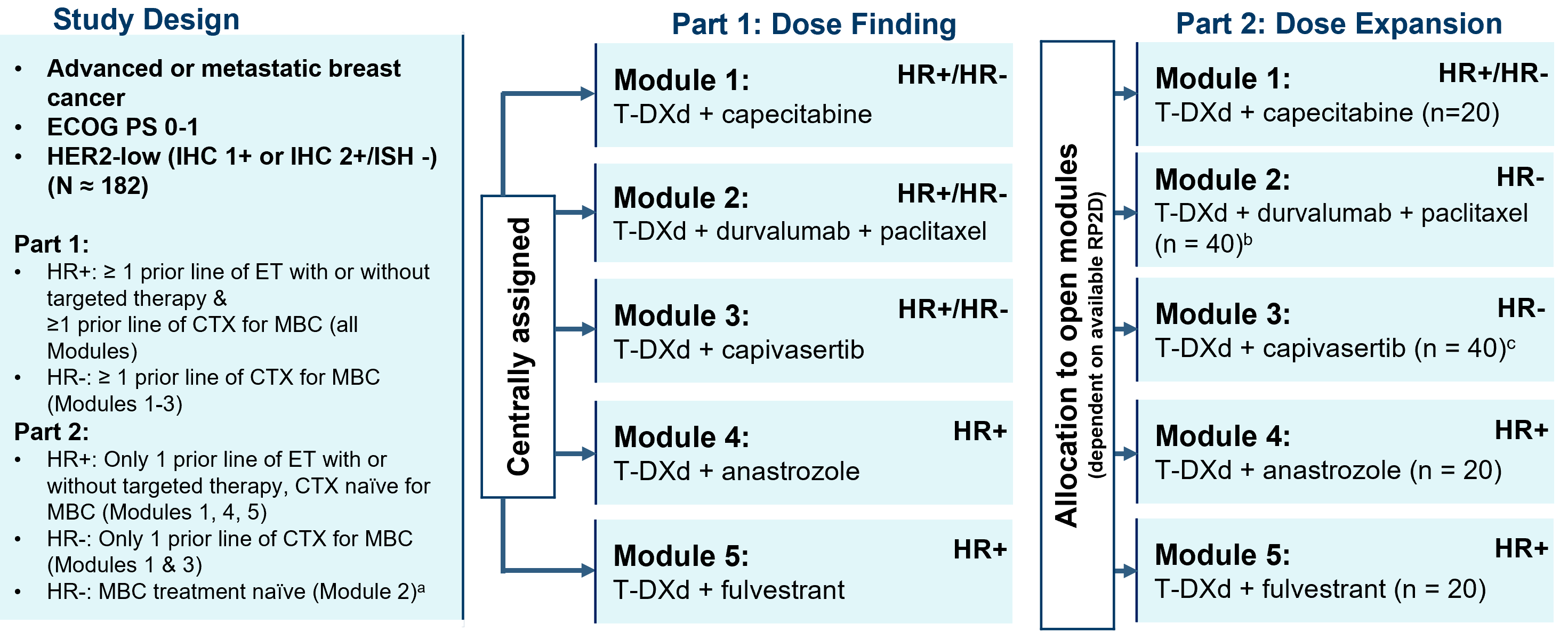
aPatients who have received CTX in the neoadjuvant or adjuvant setting are eligible, as long as they have had a disease-free interval of >12 months; bMolecularly defined subgroup of special interest, PD-L1(+); cMolecularly defined subgroup of special interest, AKT/PTEN/PIK3CA altered.

Key Eligibility Criteria1,2
| Key Inclusion Criteria | Key Exclusion Criteria |
| Adults aged ≥18 years old | Uncontrolled intercurrent illness |
| Pathologically documented BC that is advanced or metastatic; has a history of HER2-low expression (IHC 2+/ ISH- or IHC 1+ [ISH- or untested] with a validated assay; locally confirmed), and is documented as HR positive or HR negative per ASCO/CAP guidelines in the metastatic setting | Uncontrolled or significant cardiovascular disease |
| Adequate tumour sample for biomarker assessment | History of (non-infectious) ILD/pneumonitis that required steroids, has current ILD/pneumonitis, or where suspected ILD/pneumonitis cannot be ruled out by imaging at screening |
For patients with HR positive diseasea:
| Lung specific intercurrent clinically significant illnesses |
For patients with HR negative diseaseb:
| Has spinal cord compression or clinically active CNS metastases |
| ECOG PS of 0 or 1 | Active primary immunodeficiency |
| Uncontrolled infection requiring IV antibiotics, antivirals, or antifungals | |
| Prior treatment with an ADC containing an exatecan derivative that is a topoisomerase I inhibitor |
Abbreviations
ADA = anti-drug antibody
;ADC = antibody-drug conjugate
;AE = adverse event
;ASCO/CAP = American Society of Clinical Oncology/College of American Pathologists
;BC = breast cancer
;CTX = chemotherapy
;DCO = data cut-off
;DLT = dose limiting toxicity
;DOR = duration of response
;ET = endocrine therapy
;ECOG = Eastern Cooperative Oncology Group
;HER2 = human epidermal growth factor receptor 2
;HR = hormone receptor
;IHC = immunohistochemistry
;ILD = interstitial lung disease
;ISH = in-situ hybridization
;MBC = metastatic breast cancer
;ORR = objective response rate
;OS = overall survival
;PD-L1 = programmed cell death-ligand 1
;PFS = progression-free survival
;PI3KCA = phosphatidylinositol 4,5-bisphosphate 3-kinase catalytic subunit alpha
;PK = pharmacokinetics
;PS = performance status
;PTEN = phosphatase and tensin homolog
;RECIST = Response Evaluation Criteria in Solid Tumors
;RDE = recommended dose for expansion
;RP2D = recommended phase 2 dose
;T-DXd = trastuzumab deruxtecan
References
2. André F, Hamilton EP, Loi S, et al. Dose-finding and -expansion studies of trastuzumab deruxtecan in combination with other anticancer agents in patients with advanced/metastatic HER2+ (DESTINY-Breast07) and HER2-low (DESTINY-Breast08) breast cancer [poster, supplement, and abstract]. Poster presented at: American Society of Clinical Oncology (ASCO) 2022 Congress; June 3-5, 2022; Chicago, IL. J Clin Oncol. 2022;40(suppl 16). Abs 3025.
3. Jhaveri K, Hamilton E, Loi S, et al. Trastuzumab deruxtecan (T-DXd; DS-8201) in combination with other anticancer agents in patients with HER2-low metastatic breast cancer: a phase 1b, open-label, multicenter, dose-finding and dose-expansion study (DESTINY-Breast08) [poster and abstract]. Poster presented at: San Antonio Breast Cancer Symposium (SABCS) Virtual Congress; December 8-11, 2020. Cancer Res. 2021;81(suppl 4). Abs OT-03-05.
Document ID: 1592ad62-13a7-4b16-87ee-22c395bd8a67
Last updated: 09-December-2022

©2023 AstraZeneca. All rights reserved.