



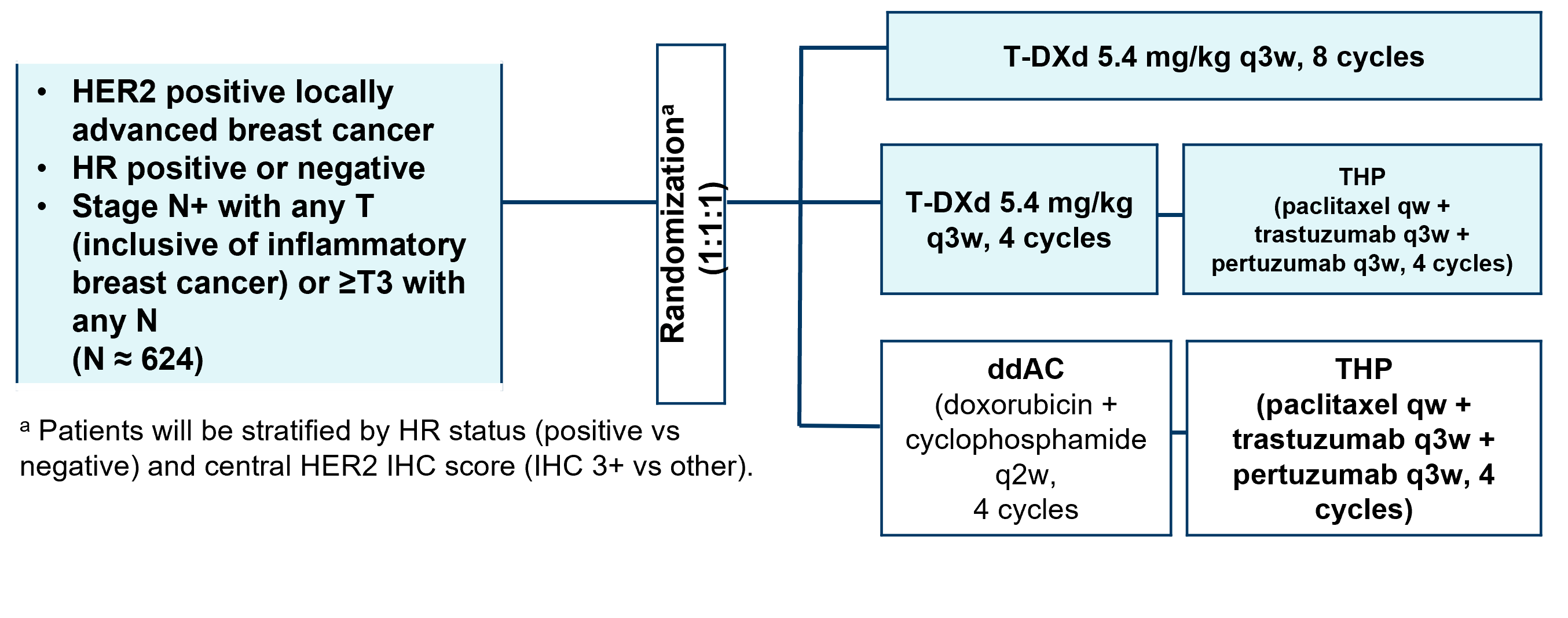
Study of T-DXd monotherapy or T-DXd followed by THP as neoadjuvant treatment vs ddAC-THP in patients with high-risk HER2 positive early BC1
A Phase III, open-label trial of neoadjuvant T-DXd monotherapy or T-DXd followed by THP compared with ddAC-THP in patients with high-risk HER2 positive early stage BC (North America, South America, Europe, Asia)1
Study Design1,2
Study Design1,2

Key Eligibility Criteria1
| Key Inclusion Criteria | Key Exclusion Criteria |
Patients must be at least 18 years of age | Prior history of invasive BC |
| Histologically documented HER2 positive early BC participants, including clinical stage at presentation (based on mammogram or breast MRI assessment): T0-4 (inclusive of inflammatory BC), N1-3, M0 or ≥T3, N0, M0 as determined by the AJCC staging system, 8th edition | Stage IV BC (determined by AJCC staging system) |
ECOG PS of 0 or 1 at randomization | Any primary malignancy within 3 years (except resected non-melanoma skin cancer, curatively treated in situ disease)
|
Adequate organ and bone marrow function | History of DCIS (except those treated with mastectomy >5 years prior to current diagnosis) |
LVEF ≥50% within 28 days before randomization | History of, current, or suspected ILD/pneumonitis |
FFPE tissue block (2 cores) or 20 freshly-cut, serial tumor slides for HER2 assessment by central lab. If blocks are incomplete or fewer than 20 slides are available, participants may eligible following discussion with the AstraZeneca Study Physician | Prior systemic therapy for the treatment of BC |
| Previous treatment with anthracyclines, cyclophosphamide or taxanes for any malignancy |
Abbreviations
AJCC = American Joint Committee on Cancer
;BC = breast cancer
;DCIS = ductal carcinoma in situ
;DMFS = distant metastasis-free survival
;ddAC = dose dense adriamycin [doxorubicin] plus cyclophosphamide
;ECOG = Eastern Cooperative Oncology Group
;FFPE = formalin-fixed paraffin-embedded
;HER2 = human epidermal growth factor receptor 2
;HR = hormone receptor
;IDFS = invasive disease-free survival
;IHC = immunohistochemistry
;ILD = interstitial lung disease
;LVEF = left ventricular ejection fraction
;MRI = magnetic resonance imaging
;ORR = objective response rate
;OS = overall survival
;pCR = pathological complete response
;PK = pharmacokinetics
;PS = performance status
;q2w = every 2 weeks
;q3w = every 3 weeks
;T-DXd = trastuzumab deruxtecan
;THP = docetaxel, trastuzumab, and pertuzumab
References
2. Harbeck N, Boileau JF, Kelley CM, et al. A phase 3, open label trial of neoadjuvant trastuzumab deruxtecan (T-DXd) monotherapy or T-DXd followed by THP compared with ddAC-THP in patinets with high-risk HER2-positive early-stage breast cancer (DESTINY-Breast11) [poster and abstract]. Poster presented at: San Antonio Breast Cancer Symposium (SABCS) 2021 Virtual Meeting. December 7-10, 2021. Cancer Res. 2022;82(suppl 4). Poster OT1-12-04.
Please note that this content may contain some data and/or patient populations which are considered off-label in your country. Providing this information does not constitute any recommendation for use. AstraZeneca is providing this material as an information service and professional courtesy.
To help us improve our content for health care professionals, please take this short survey.

©2023 AstraZeneca. All rights reserved.