



Study of T-DXd in Patients With or Without BM Who Have Been Previously Treated Advanced or Metastatic HER2 Positive BC1
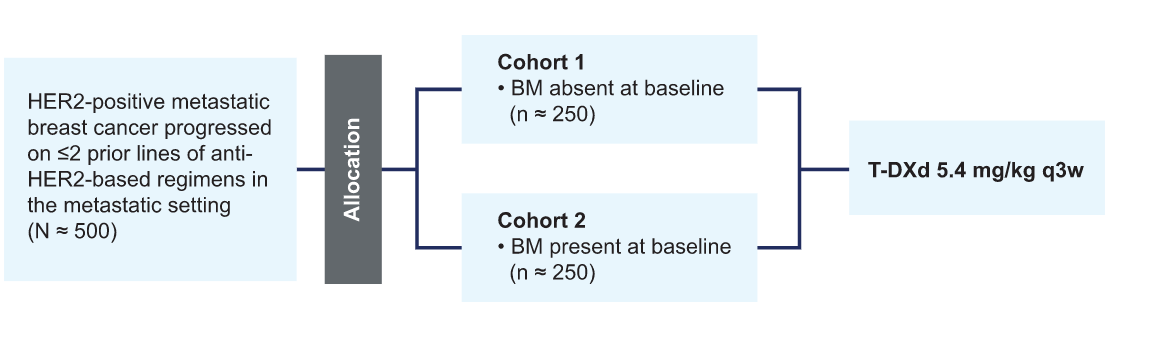
A Phase IIIb/IV, open-label, multinational, multicenter trial of T-DXd in patients with or without baseline BM with previously treated advanced or metastatic HER2 positive BC (North America, Europe, Asia, Australia)1
Study Design2
Study Design2

aAccording to RECIST version 1.1 by ICR; bPatients who develop isolated CNS progression, receive local therapy, and continue on protocol therapy; cPatients who develop isolated CNS progression, receive local therapy, continue on protocol therapy, and have a subsequent documented disease progression per RECIST version 1.1; dAccording to CNS RECIST version 1.1 by ICR (assessment of CNS RECIST endpoints will only include target lesions within the CNS); eMeasured by EORTC QLQ-C30, NANO scale, cognitive tests, MDASI-BT (patients with BM), and SGRQ-I (patients with ILD/pneumonitis).
Key Eligibility Criteria1,2
| Key Inclusion Criteria | Key Exclusion Criteria |
| Pathologically documented breast cancer that is: unresectable/advanced or metastatic BC confirmed HER2 positive (overexpression and/or amplification) as determined by ASCO-CAP guidelines | Known or suspected leptomeningeal disease |
For cohort 1, no evidence of BM; for cohort 2, untreated BM at contrast brain screening MRI/CT not needing immediate local therapy or previously treated stable or progressing BM | Prior exposure to tucatinib treatment |
| Patients with BM must be neurologically stable | Persistent toxicities (CTCAE grade >1) caused by previous anticancer therapy, excluding alopecia |
For participants requiring radiotherapy due to BMs, there should be an adequate washout period before day of first dosing:
| Based on screening brain MRI/CT, participants must not have any of the following: any untreated brain lesions >2.0 cm in size, ongoing use of systemic corticosteroids for control of symptoms of BM; any brain lesion thought to require immediate local therapy, have poorly controlled (>1/week) generalized or complex partial seizures, or manifest neurologic progression due to BM despite CNS-directed therapy |
| ECOG PS of 0 or 1 | Has spinal cord compression |
Patients must provide an FFPE tumor sample (archival tissue or fresh biopsy) for tissue-based analysis including assessment of HER2 expression, other predictive biomarkers, and tumor mutational burden | Uncontrolled infection requiring IV antibiotics, antivirals, or antifungals |
Radiological or objective evidence of disease progression on or after ≥1 HER2-targeted therapy or within 6 months after adjuvant treatment with HER2-targeted therapies (≤2 lines/regimens of therapy in the metastatic setting) | History of (non-infectious) ILD/pneumonitis that required steroids, has current ILD/pneumonitis, or where suspected ILD/pneumonitis cannot be ruled out by imaging at screening |
| Adequate organ and bone marrow function ≤14 days before the day of first dosing | Prior exposure, without adequate treatment washout period before the day of first dosing, to chloroquine/hydroxychloroquine <14 days; immunotherapy (non-antibody-based therapy), retinoid therapy, or hormonal therapy <3 weeks (<2 weeks or 5 half-lives, whichever is longer, for small-molecule targeted agents such as 5-fluorouracil-based agents, folinate agents, and weekly paclitaxel); nitrosoureas or mitomycin C <6 weeks; TKIs approved for the treatment of NSCLC <1 week (baseline CT scan must be completed after discontinuation of TKI); antibody-based anticancer therapy <4 weeks; or any concurrent anticancer treatment. |
| LVEF ≥50% within 28 days before enrollment | Concurrent use of hormonal therapy for non-cancer- related conditions is allowed |
| Negative pregnancy test (serum) for women of childbearing potential | Palliative radiotherapy with a limited field of radiation ≤2 weeks (palliative stereotactic radiation therapy to other areas ≤1 week), or with wide field of radiation, radiation to the chest or to >30% of the bone marrow ≤4 weeks before the first study dose |
Prior exposure to immunosuppressive medication, except for intranasal and inhaled corticosteroids or systemic corticosteroids at doses ≤2 mg/day of dexamethasone or equivalent, ≤14 days prior to first study dose |
Abbreviations
ASCO/CAP = American Society of Clinical Oncology/College of American Pathologists
;BC = breast cancer
;BM = brain metastases
;BMFS = brain metastases-free survival
;CNS = central nervous system
;CT = computed tomography
;CTCAE = Common Terminology Criteria for Adverse Events
;DOR = duration of response
;DOT = duration of treatment
;ECOG = Eastern Cooperative Oncology Group
;EORTC QLQ-C30 = European Organization for Research and Treatment of Cancer Quality of Life Questionnaire-Core 30
;FFPE = formalin-fixed paraffin-embedded
;HER2 = human epidermal growth factor receptor 2
;HRQoL = health-related quality of life
;ICR = independent central review
;ILD = interstitial lung disease
;LVEF = left ventricular ejection fraction
;MDASI-BT = MD Anderson Symptom Inventory Brain Tumor
;MRI = magnetic resonance imaging
;NANO = Neurologic Assessment in Neuro-Oncology
;NSCLC = non-small cell lung cancer
;ORR = objective response rate
;OS = overall survival
;PFS = progression-free survival
;PFS2 = progression-free survival after subsequent anticancer therapy
;PS = performance status
;q3w = every 3 weeks
;RANO-BM = Response Assessment Criteria for Neuro-Oncology Brain Metastases
;RECIST = Response Evaluation Criteria in Solid Tumors
;SGRQ-I = St. George's Respiratory Questionnaire - Idiopathic Pulmonary fibrosis-specific
;T-DXd = trastuzumab deruxtecan
;TFST = time to first subsequent therapy
;TKI = tyrosine kinase inhibitor
References
2. Lin N, Ciruelos E, Jerusalem G, et al. Open-label, phase 3b/4 study of trastuzumab deruxtecan (T-DXd) in patients with or without baseline brain metastasis with advanced/metastatic human epidermal growth factor receptor 2-positive breast cancer: DESTINY-Breast12 [poster]. Presented at: San Antonio Breast Cancer Symposium (SABCS) 2022, December 6-10, 2022; San Antonio, TX. Poster OT2-16-02.
Please note that this content may contain some data and/or patient populations which are considered off-label in your country. Providing this information does not constitute any recommendation for use. AstraZeneca is providing this material as an information service and professional courtesy.
To help us improve our content for health care professionals, please take this short survey.

©2023 AstraZeneca. All rights reserved.