

Patient Exposure (28.3 Month Follow up)1
Despite the longer treatment duration in the acala-containing arms, the frequency of discontinuations due to AEs was not higher1
Treatment Discontinuations1
| Acala-O (N = 179) | O-Clb (N = 177) | ||||
| Variable | Acala | O | Acala (n=179) | O | Clb |
| Duration of treatment, median (range), monthsa | 27.7 (25.0-32.8) | 5.5 (5.5-5.6) | 27.7 (24.8-33.0) | 5.6 (5.5-5.9) | 5.5 (5.5-5.7) |
| Discontinued regimen, n (%) | 37 (20.7) | 36 (20.1) | 32 (18.1) | ||
| 20 (11.2) | 16 (8.9) | 25 (14.1) | ||
| 0 | 1 (0.6) | 1 (0.6) | ||
| 6 (3.4) | 7 (3.9) | 3 (1.7) | ||
| 1 (0.6) | 1 (0.6) | 1 (0.6) | ||
| 4 (2.2) | 5 (2.8) | 1 (0.6) | ||
| 4 (2.2)b | 3 (1.7)c | 0 | ||
| AEs, n (%) | |||||
| 60 (33.7) | 18 (10.1) | 28 (15.6) | 21 (12.4) | 37 (21.9) |
| 14 (7.9) | - | 5 (2.8) | - | 48 (28.4) |
aContinuous acalabrutinib treatment resulted in a longer reporting period for Acala-O, and Acala vs O-Clb; bOther: patient decision (n=1), dose interruption >28 days (n=2; anemia and pneumonia), and risk of bleeding while taking aspirin and clopidogrel (n=1); cOther: patient decision (n=1), Richter transformation (n=1), and dose interruption >28 days (n=1; grade 4 thrombocytopenia).
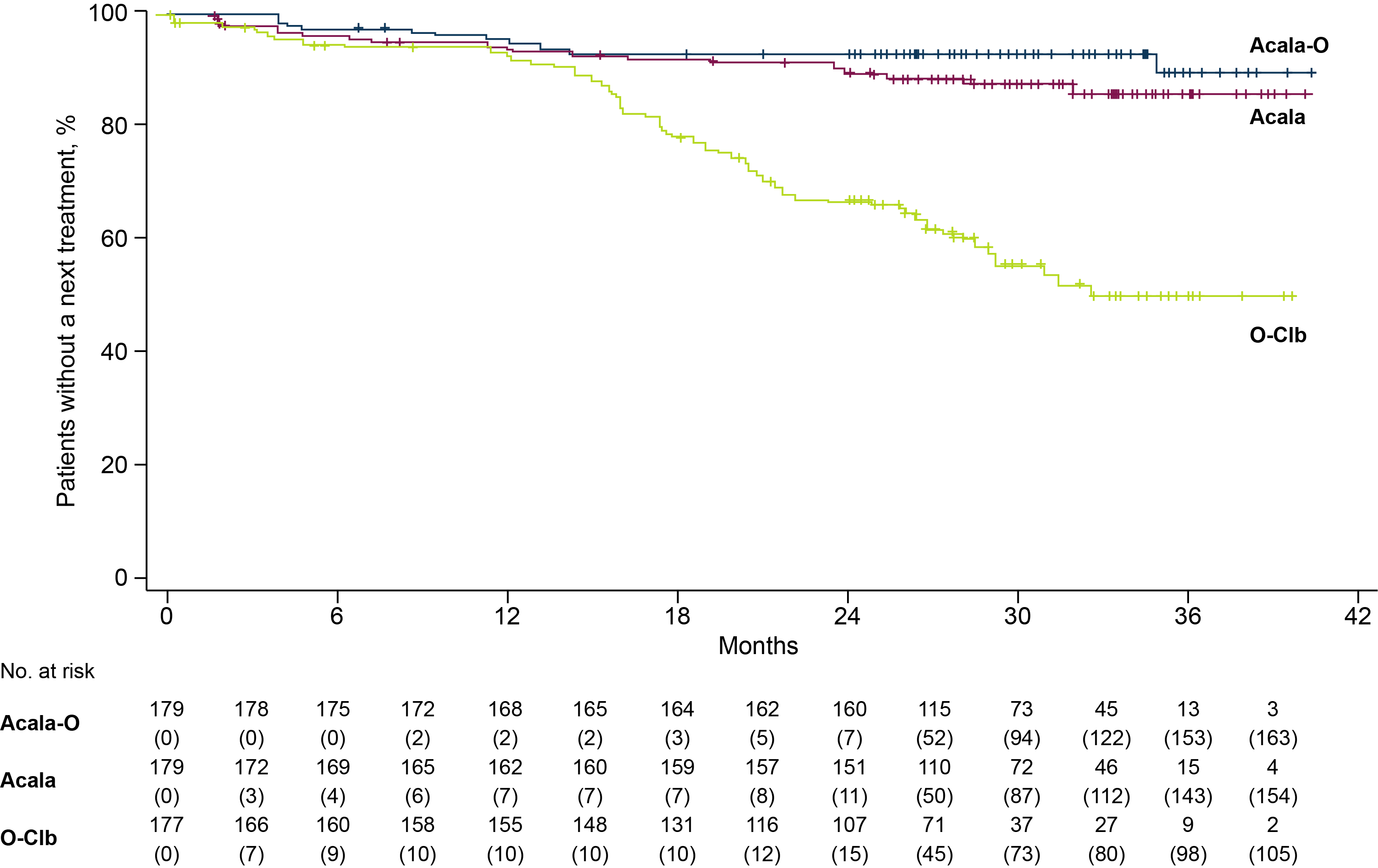
A higher percentage of patients on O-Clb required a subsequent treatment versus patients on acalabrutinib regimens1
Median time to next treatment was not reached in any group1
Kaplan–Meier Assessments of Time to Next Treatment.1
Kaplan–Meier Assessments of Time to Next Treatment.1
- Hazard Ratio
- Number at Risk
Abbreviations
Acala = acalabrutinib
;AE = adverse event
;Clb = chlorambucil
;CI = confidence interval
;O = obinutuzumab
;vs = versus
References
1. Sharman JP, Egyed M, Jurczak W et al. Acalabrutinib with or without obinutuzumab versus chlorambucil and obinutuzumab for treatment-nave chronic lymphocytic leukemia (ELEVATE TN): a randomized, controlled phase 3 trial [article and supplementary appendix]. Lancet. 2020;395:1278-91.
Document ID: 780f9b60-d375-4516-97d6-9ba58f025de4
Last updated: 17-April-2023