



DESTINY-Breast06: Study Design
Study of T-DXd vs Physician’s Choice Chemotherapy in Patients With HR+, HER2-Low or HER2-ultralow Metastatic Breast Cancer With Prior Endocrine Therapy1
- DESTINY-Breast06 (NCT04494425) is a phase 3, open-label, multicenter, randomized study being conducted to evaluate the efficacy, safety, and tolerability of T-DXd compared with TPC (paclitaxel, nab-paclitaxel, or capecitabine) in chemotherapy-naive patients with HR+ HER2-low (IHC 1+ or IHC 2+/ISH-) or HER2-ultralow (IHC 0 with membrane staining) breast cancer whose disease has progressed on ≥1 prior line of ET in the metastatic setting.1,2
- A total of 866 patients were randomly assigned 1:1 to receive either T-DXd (n = 436) or TPC (n = 430).1
DESTINY-Breast06 Study Design1
DESTINY-Breast06 Study Design1
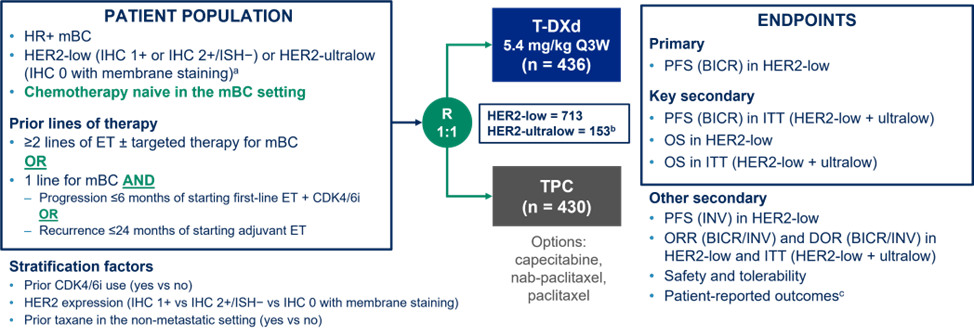
aStudy enrollment was based on central HER2 testing. HER2 status was determined based on the most recent evaluable HER2 IHC sample prior to randomization; HER2-ultralow defined as faint, partial staining of the membrane in ≤10% of tumor cells (also known as IHC >0<1+).
bHER2-ultralow status as determined by IRT data (note: efficacy analyses in the HER2-ultralow subgroup were based on n = 152 as determined per central laboratory testing data).
cTo be presented separately.
Key Eligibility Criteria2
| Key Inclusion Criteria | Key Exclusion Criteria |
≥18 years of age | Ineligible for all investigator’s choice chemotherapy arms |
Pathologically documented breast cancer that
| Lung-specific intercurrent clinically significant illnesses |
No prior chemotherapy for advanced or metastatic breast cancer | Uncontrolled or significant CVD or infection |
Has adequate tumor samples for assessment of HER2 status | Prior documented ILD/pneumonitis that required steroids or active or suspected ILD/pneumonitis that cannot be ruled out by imaging at screening |
Has disease progression within 6 months of starting first-line metastatic treatment with an ET combined with a CDK4/6i or disease progression on ≥2 previous lines of ET with or without a targeted therapy in the metastatic setting* | Spinal cord compression or active CNS metastases |
| Protocol-defined adequate organ and bone marrow function | Prior participation in a previous T-DXd study regardless of treatment received |
| Concurrent enrollment in another clinical study, unless it is an observational (non-interventional) clinical study during the follow-up period of a prior interventional study |
*Disease recurrence while on the first 24 months of starting adjuvant ET will be considered a line of therapy; these patients will only require 1 line of ET in the metastatic setting.
Abbreviations
BICR = blinded independent central review
;CDK4/6i = cyclin-dependent kinase 4/6 inhibitor
;CNS = central nervous system
;CVD = cardiovascular disease
;DOR = duration of response
;ET = endocrine therapy
;HER2 = human epidermal growth factor receptor 2
;HR = hormone receptor
;IHC = immunohistochemistry
;ILD = interstitial lung disease
;INV = investigator assessed
;IRT = interactive response technology
;ISH = in situ hybridization
;ITT = intent-to-treat
;mBC = metastatic breast cancer
;ORR = objective response rate
;OS = overall survival
;PFS = progression-free survival
;Q3W = every 3 weeks
;R = randomization
;RECIST = Response Evaluation Criteria in Solid Tumors
;T-DXd = trastuzumab deruxtecan
;TPC = treatment of physician's choice
References
1. Curigliano G, Hu X, Dent R, et al. Trastuzumab deruxtecan vs physician’s choice of chemotherapy in patients with hormone receptor–positive, human epidermal growth factor receptor 2 (HER2)–low or HER2-ultralow metastatic breast cancer with prior endocrine therapy: primary results from DESTINY-Breast06. Presented at 2024 ASCO Annual Meeting; May 31-June 4, 2024; Chicago, Illinois. Presentation LBA1000.
2. AstraZeneca. Study of trastuzumab deruxtecan (T-DXd) vs investigator's choice chemotherapy in HER2-low, hormone receptor positive, metastatic breast cancer (DB-06). ClinicalTrials.gov website. https://clinicaltrials.gov/ct2/show/NCT04494425
Please note that this content may contain some data and/or patient populations which are considered off-label in your country. Providing this information does not constitute any recommendation for use. AstraZeneca is providing this material as an information service and professional courtesy.
To help us improve our content for health care professionals, please take this short survey.
Document ID: c791d159-0a5c-4180-b38f-cd5e26050804
Last updated: 28-June-2024

©2023 AstraZeneca. All rights reserved.