

Safety Summary1
| Event | Acalabrutinib (n=266) | Ibrutinib (n=263) |
| Duration of treatment exposure, median (range), months | 38.3 (0.3-55.9) | 35.5 (0.2-57.7) |
| Any grade AEs | 260 (97.7) | 256 (97.3) |
Grade ≥3 AEs | 183 (68.8) | 197 (74.9) |
| AEs leading to treatment discontinuation | 39 (14.7) | 56 (21.3) |
| Serious AEs | 143 (53.8) | 154 (58.6) |
| Deaths due to AEsa | 17 (6.4) | 25 (9.5) |
Note: Values are reported as n (%) unless stated otherwise.
aIncludes deaths occurring within 30 days of last dose; deaths occurring after the start of subsequent anticancer therapy were not included in the assessment of deaths within 30 days of last dose, regardless of time after last dose.
Acalabrutinib was associated with a lower incidence of any grade diarrhea, arthralgia, hypertension, contusion, and atrial fibrillation but a higher incidence of any grade headache and cough1
| Any grade | Grade ≥3 | |||
| Events, n (%) | Acalabrutinib (n=266) | Ibrutinib (n=263) | Acalabrutinib (n=266) | Ibrutinib (n=263) |
| Diarrheaa,b | 92 (34.6) | 121 (46.0) | 3 (1.1) | 13 (4.9) |
| Headachea,b | 92 (34.6) | 53 (20.2) | 4 (1.5) | 0 |
| Cougha | 77 (28.9) | 56 (21.3) | 2 (0.8) | 1 (0.4) |
| URTI | 71 (26.7) | 65 (24.7) | 5 (1.9) | 1 (0.4) |
| Neutropenia | 56 (21.1) | 65 (24.7) | 52 (19.5) | 60 (22.8) |
| Pyrexia | 62 (23.3) | 50 (19.0) | 8 (3.0) | 2 (0.8) |
| Arthralgiaa | 42 (15.8) | 60 (22.8) | 0 | 2 (0.8) |
| Hypertensiona,b | 23 (8.6) | 60 (22.8) | 11 (4.1) | 23 (8.7) |
| Anemia | 58 (21.8) | 49 (18.6) | 31 (11.7) | 34 (12.9) |
| Fatigueb | 54 (20.3) | 44 (16.7) | 9 (3.4) | 0 |
| Nausea | 47 (17.7) | 49 (18.6) | 0 | 1 (0.4) |
| Contusiona | 31 (11.7) | 48 (18.3) | 0 | 1 (0.4) |
| Pneumonia | 47 (17.7) | 43 (16.3) | 28 (10.5) | 23 (8.7) |
| Atrial fibrillationa | 24 (9.0) | 41 (15.6) | 12 (4.5) | 9 (3.4) |
| Thrombocytopenia | 40 (15.0) | 35 (13.3) | 26 (9.8) | 18 (6.8) |
Notes: Higher incidence in bold for terms with statistical differences. Includes AEs reported at ≥15% incidence (any grade) in either arm.
Among most common AEs above, grade 5 were reported in 5 (1.9%) acalabrutinib patients (pyrexia, n=1; pneumonia, n=4) and 4 (1.5%) ibrutinib patients (URTI, n=1; pneumonia, n=3).
aBased on Barnard's exact test, two-sided P-value <0.05 without multiplicity adjustment for any grade events; bBased on Barnard's exact test, two-sided P-value <0.05 without multiplicity adjustment for grade ≥3 events.
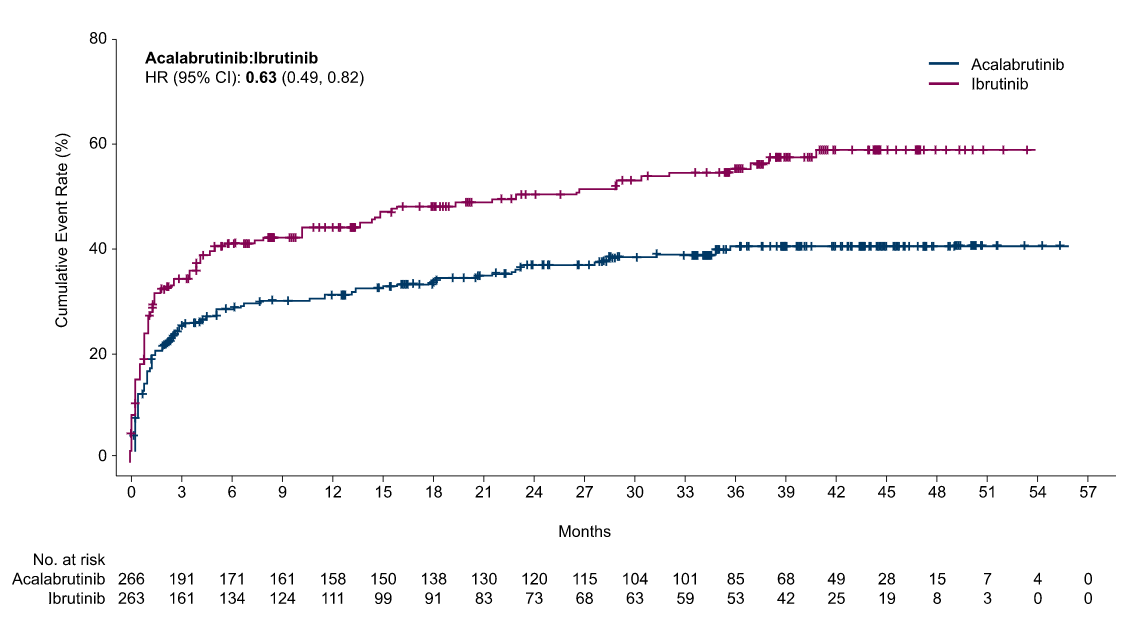
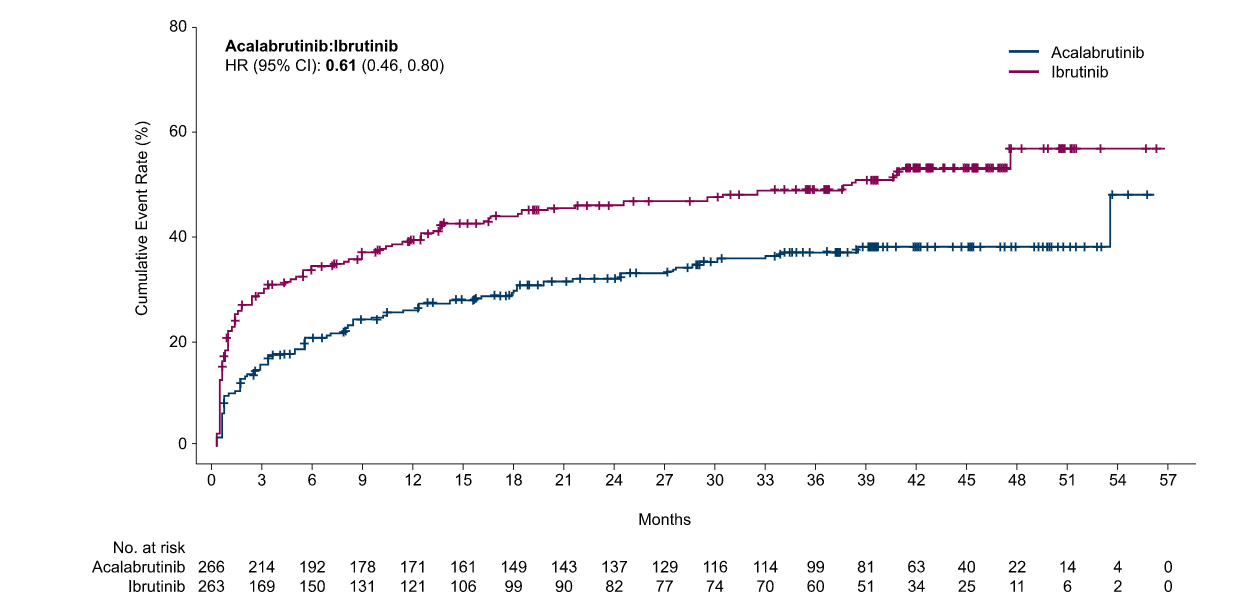
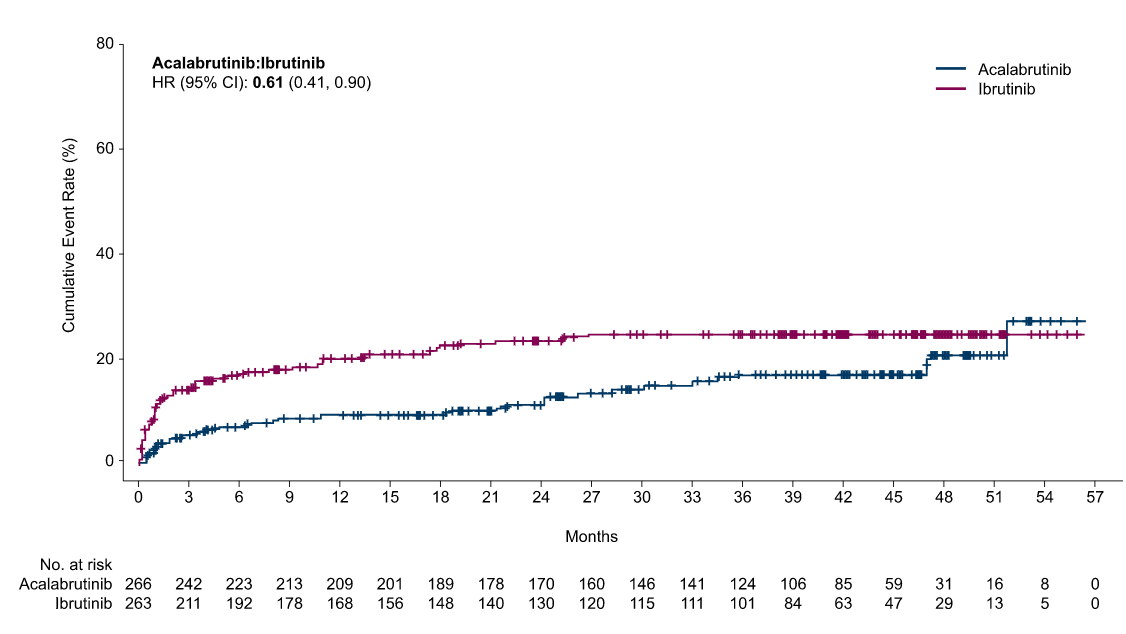
Cumulative Incidence KM Curves for Select AEs1
- Bleeding
- Diarrhea
- Arthralgia
Cumulative incidences of any grade bleeding events1
Cumulative incidences of any grade diarrhea1
Cumulative incidences of any grade arthralgia1
Events of Clinical Interest2
| Acalabrutinib (n=266) | Ibrutinib (n=263) | |||
| Events, n (%) | Any grade | Grade ≥3 | Any grade | Grade ≥3 |
| Cardiac events | 64 (24.1) | 23 (8.6) | 79 (30) | 25 (9.5) |
Atrial fibrillationa | 25 (9.4)b | 13 (4.9) | 42 (16) | 10 (3.8) |
Hypertensionc | 25 (9.4) | 11 (4.1) | 61 (23.2) | 24 (9.1) |
| Bleeding eventsd | 101 (38) | 10 (3.8) | 135 (51.3) | 12 (4.6) |
Major bleeding eventse | 12 (4.5) | 10 (3.8) | 14 (5.3) | 12 (4.6) |
| Cytopenia | 108 (40.6) | 78 (29.3) | 113 (43) | 94 (35.7) |
| 58 (21.8) | 31 (11.7) | 49 (18.6) | 34 (12.9) |
| 62 (23.3) | 58 (21.8) | 68 (25.9) | 63 (24) |
| 42 (15.8) | 27 (10.2) | 36 (13.7) | 18 (6.8) |
| Hepatoxicity | 15 (5.6) | 5 (1.9) | 22 (8.4) | 4 (1.5) |
| Infections | 208 (78.2) | 82 (30.8) | 214 (81.4) | 79 (30) |
| ILD/pneumonitisd | 7 (2.6) | 1 (0.4) | 17 (6.5) | 2 (0.8) |
| SPMs | 50 (18.8) | 23 (8.6) | 36 (13.7) | 15 (5.7) |
| 24 (9) | 16 (6) | 20 (7.6) | 14 (5.3) |
Grade ≥3 infections and Richter transformation were similar for both arms1
Incidence of Grade ≥3 infections and Richter transformation in ELEVATE-RR1
Incidence of Grade ≥3 infections and Richter transformation in ELEVATE-RR1
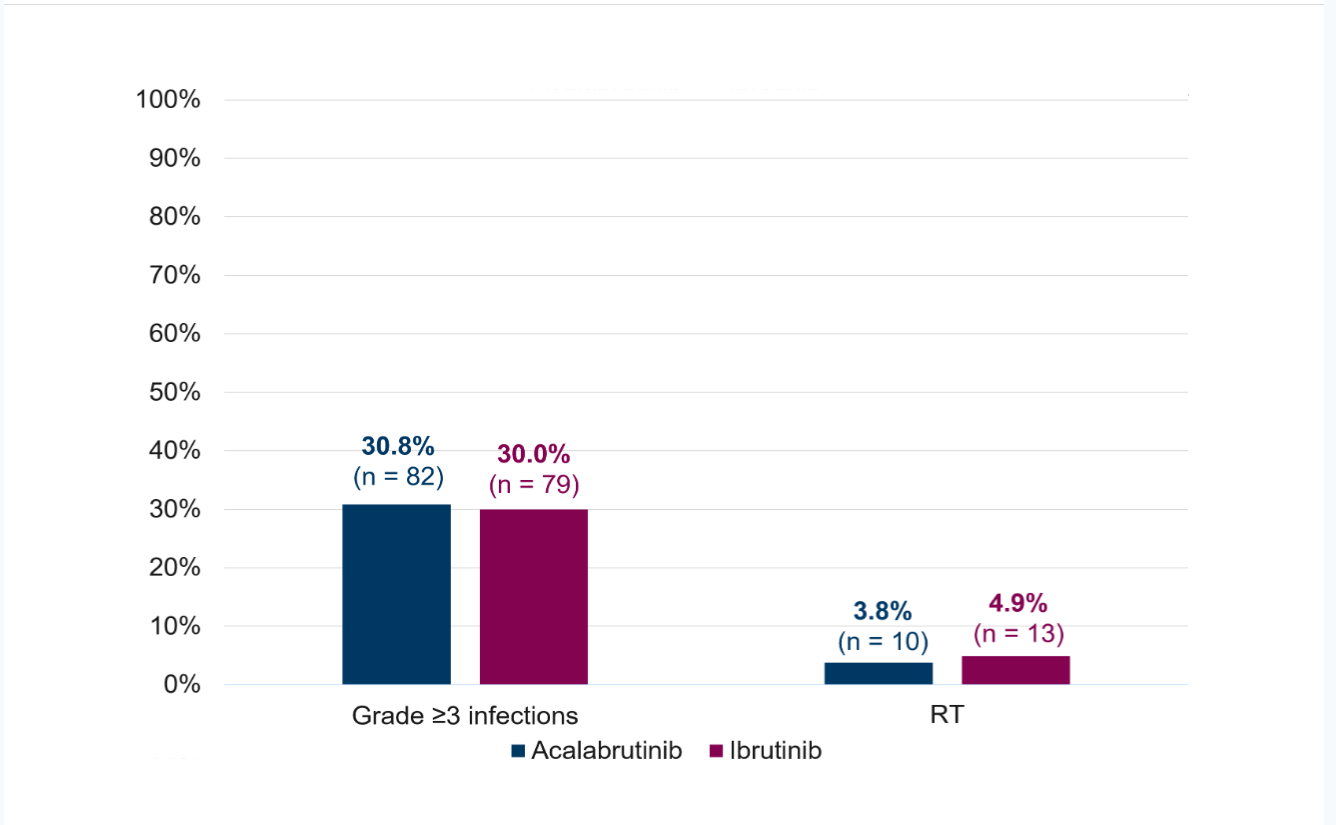
Difference in the Incidence of grade 3 or higher infection: p=0.8777
Summary of Deaths2
| Events, no. (%) | Acalabrutinib (n=266) | Ibrutinib (n=263) |
| Death | 62 (23.3)a | 73 (27.8) |
| Primary cause of death | ||
| CLL disease progression | 21 (7.9) | 22 (8.4) |
| Richter transformation | 3 (1.1) | 7 (2.7) |
| Otherb | 5 (1.9) | 3 (1.1) |
| Unknown | 5 (1.9) | 8 (3.0) |
| Adverse event | 28 (10.5) | 33 (12.5) |
| Within 30 days of last dose | 17 (6.4) | 25 (9.5) |
| Beyond 30 days after last dosec | 11 (4.1) | 8 (3.0) |
Abbreviations
AE = adverse event
;AEs = adverse events
;CI = confidence interval
;CLL = chronic lymphocytic leukemia
;HR = hazard ratio
;HR = heart rate
;ILD = interstitial lung disease
;NE = not estimable
;NMSC = non-melanoma skin cancer
;No. = number
;OS = overall survival
;RT = Richter transformation
;SPM = second primary malignancies
;URTI = upper respiratory tract infection
References
2. Byrd JC, Hillmen P, Ghia P, et al. Acalabrutinib versus ibrutinib in previously treated chronic lymphocytic leukemia: Results of the first randomized Phase III trial. J. Clin. Oncol. 2021. https://doi.org/10.1200/JCO.21.01210.
Document ID: b5f1a3c0-28eb-4186-8709-e3ddba7b6695
Last updated: 17-April-2023