



DESTINY-Breast01: BM Subgroup Efficacy Results (August 1, 2019 DCO Date)
Systemic Efficacy of T-DXd 5.4 mg/kg1
BM Subgroup (n=24) | Non-BM Subgroup (n=160) | All Patients (N=184) | |
| Confirmed ORR (CR + PR) by ICR, n (%)a | 14 (58.3) 95% CI, 36.6-77.9 | 98 (61.3) 95% CI, 53.2-68.8 | 112 (60.9) 95% CI, 53.4-68.0 |
| CR | 1 (4.2) | 10 (6.3) | 11 (6.0) |
| PR | 13 (54.2) | 88 (55.0) | 101 (54.9) |
| SD | 8 (33.3) | 59 (36.9) | 67 (36.4) |
| PD | 1 (4.2) | 2 (1.3) | 2 (1.1) |
| Not evaluable | 1 (4.2) | 1 (0.6) | 3 (1.6) |
| BOR in the brain (CR + PR), n (%)b | 8 (47.1) | – | – |
| Median DOR (CR or PR), months, (95% CI) | 16.9 (5.7-16.9) | 14.8 (13.8-NE) | 14.8 (13.8-16.9) |
| Median PFS, months, (95% CI) | 18.1 (6.7-18.1) | 16.4 (12.7-NE) | 16.4 (12.7-NE) |
Best Change in Tumor Size1
Best Percent Change From Baseline in Sum of the Longest Diameters of Measurable Tumors By ICR.1,a
Best Percent Change From Baseline in Sum of the Longest Diameters of Measurable Tumors By ICR.1,a
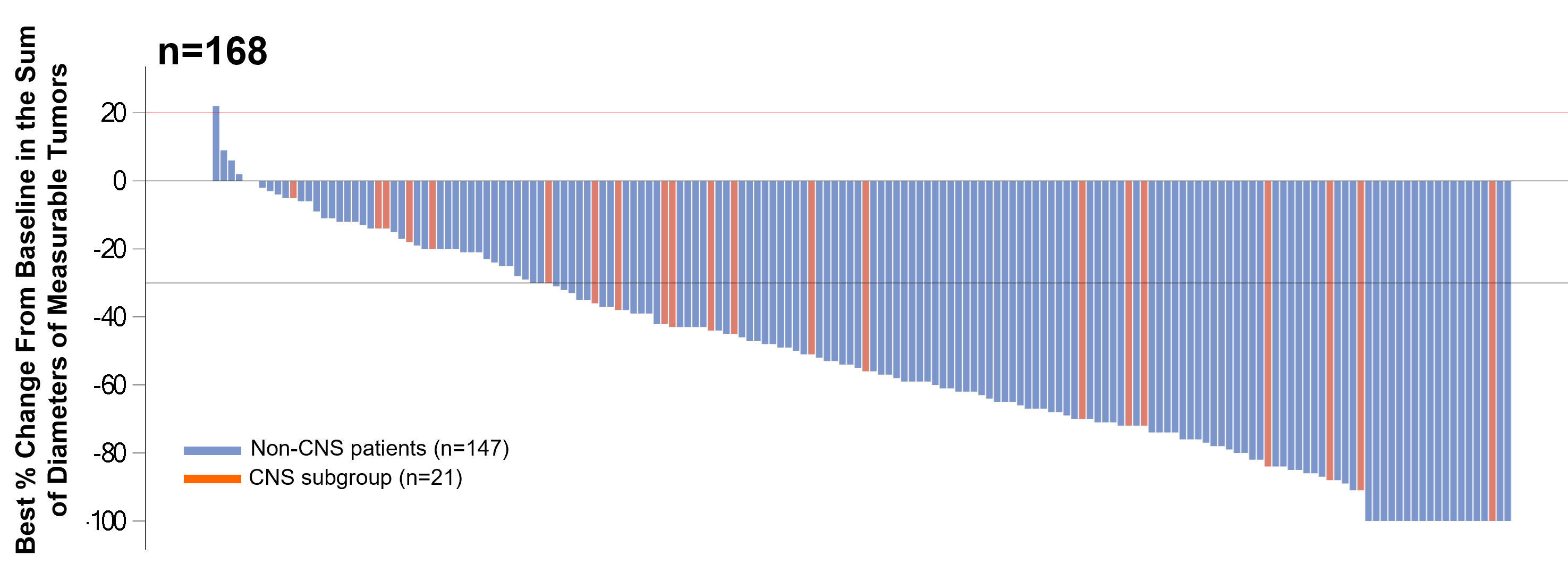
aIncludes patients who had both baseline and postbaseline target lesion assessments by ICR. The line at 20% indicates PD; the line at −30% indicates PR. A total of 168 patients from the enrolled analysis set of 184 patients, for whom data from both baseline and postbaseline assessments of target lesions by ICR were available.
Progression-Free Survival1
Progression-Free Survival.1
Progression-Free Survival.1
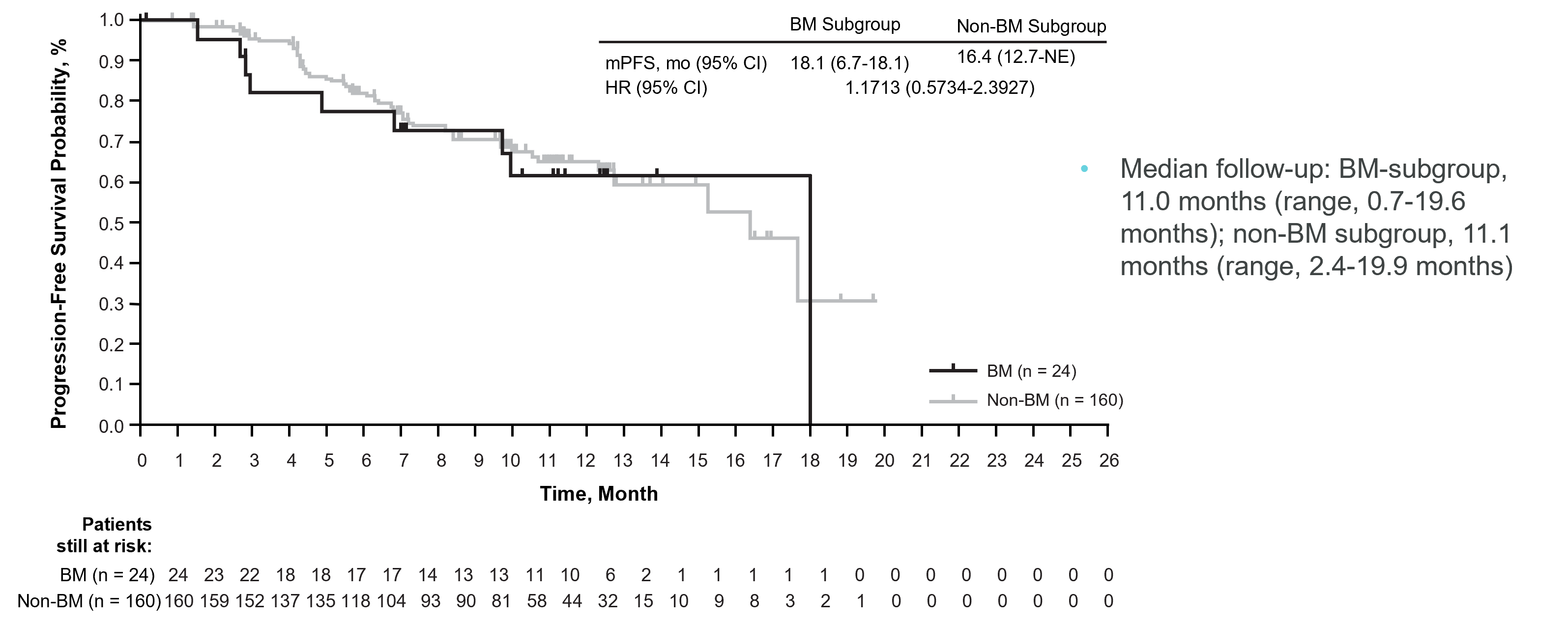
The tick marks in each panel indicate patient data that were censored
Central Nervous System Response1
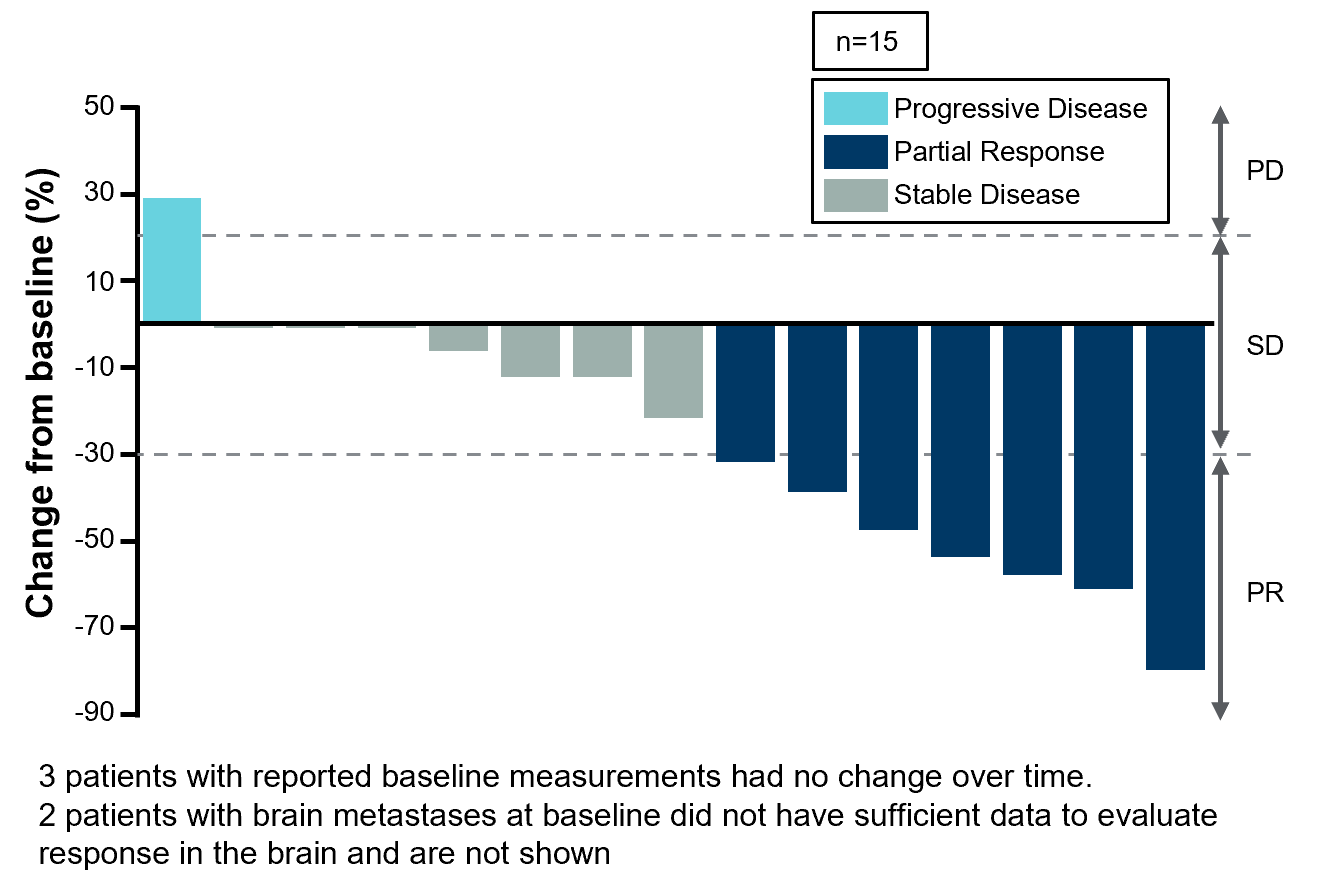
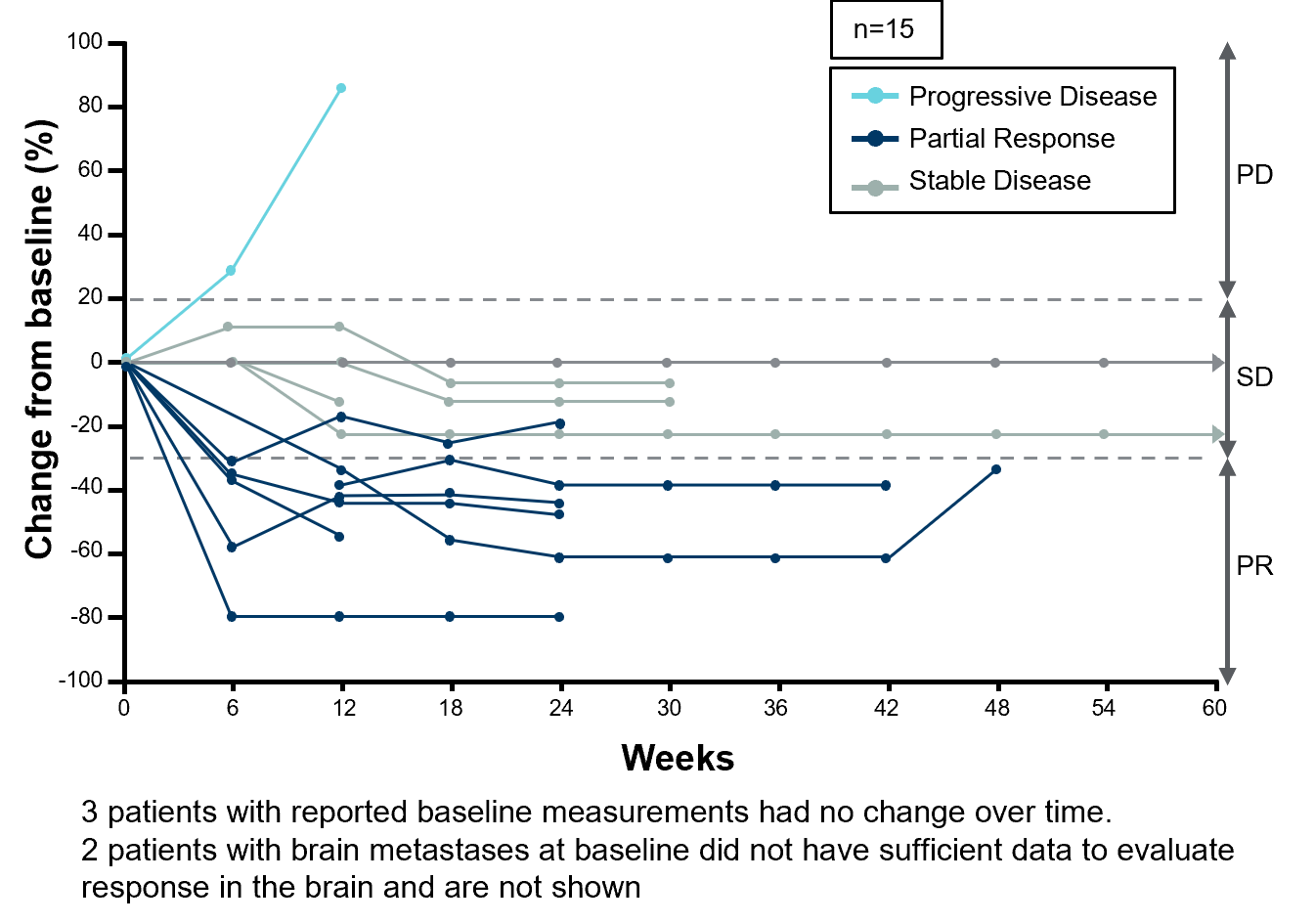
- In the BM subgroup, 17/24 patients had brain lesions at baseline; data were available to evaluate responses in the brain for 15 patients1
- 7/17 (41.2%) had a reduction in brain lesion diameters consistent with a best response of PR in the brain based on the investigator's assessment
Best Response in Brain Lesions in the BM Subgroup.1
Best Response in Brain Lesions in the BM Subgroup.1
Brain Lesion Measurements Over Time in Patients in the BM Subgroup.1
Brain Lesion Measurements Over Time in Patients in the BM Subgroup.1
Sites of Progression1
- Sites of progression were similar among all patients and the BM subgroup1
- Only 2.2% (4 of 184) had BM progression, including 2 patients who had BM disease at baseline1
- BM progression events:1
- At 75 and 85 days in the baseline BM subgroup
- At 323 and 498 days in patients without a history of BM metastases
| Site of PD | CNS Subgroup (n=24) | Non-CNS Patients (n=160) | All Patients (N=184) |
| Patients with progression on study, n (%) | 8 (33.3) | 40 (25.0) | 48 (26.1) |
| Lung | 3 (12.5) | 17 (10.6) | 20 (10.9) |
| Liver | 2 (8.3) | 12 (7.5) | 14 (7.6) |
| Brain | 2 (8.3) | 2 (1.3) | 4 (2.2) |
| Bone | 1 (4.2) | 2 (1.3) | 3 (1.6) |
| Lymph node | 1 (4.2) | 11 (6.9) | 12 (6.5) |
| Pleura | 1 (4.2) | 1 (0.6) | 2 (1.1) |
| Soft tissue | 1 (4.2) | 0 | 1 (0.5) |
| Chest wall | 0 | 4 (2.5) | 4 (2.2) |
| Muscle | 0 | 1 (0.6) | 1 (0.5) |
| Peritoneum | 0 | 1 (0.6) | 1 (0.5) |
For patients in the CNS subgroup, a CT or MRI of the brain was mandatory every 6 wks (±7 days).
Abbreviations
BM = brain metastases
;BOR = best overall response
;CR = complete response
;CT = computed tomography
;DCO = data cut-off
;DOR = duration of response
;HR = hormone receptor
;ICR = independent central review
;mo = months
;mPFS = median progression-free survival
;MRI = magnetic resonance imaging
;NE = not evaluable
;ORR = objective response rate
;PD = progressive disease
;PFS = progression-free survival
;PR = partial response
;SD = stable disease
;T-DXd = trastuzumab deruxtecan
References
Please note that this content may contain some data and/or patient populations which are considered off-label in your country. Providing this information does not constitute any recommendation for use. AstraZeneca is providing this material as an information service and professional courtesy.
To help us improve our content for health care professionals, please take this short survey.

©2023 AstraZeneca. All rights reserved.